Building a Practical Plan for Watershed Improvement
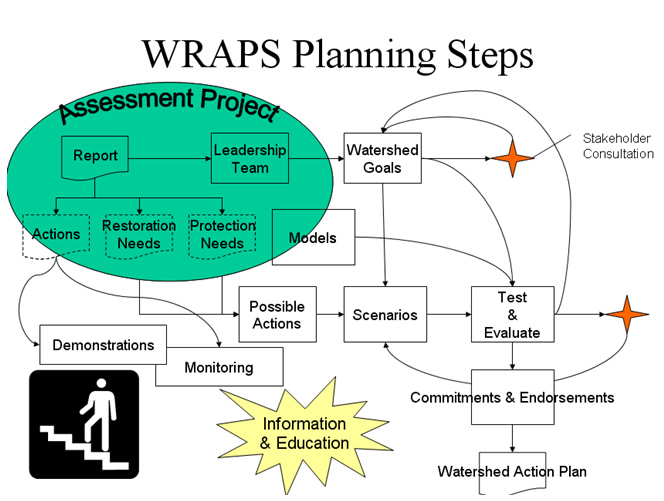
A WRAPS Planning Project transforms stakeholder priorities and watershed information into a clear Action Plan identifying what should be done, who will be involved, and how progress will be measured.
Protection priorities
Management strategies
Measurable results
Keep Stakeholders at the Center
Planning works best when stakeholders understand the available information and actively participate in decisions about restoration and protection.
2
Inform and consult
Information, Education & Stakeholder Consultation
Stakeholder education and involvement are important throughout the WRAPS process, but they are especially important during planning because the community is making decisions about future watershed actions.
Stakeholders should help shape the Action Plan—not simply receive it after decisions have already been made.
Ways to engage stakeholders
Use workshops, informational meetings, watershed tours, brochures, and digital resources to explain watershed conditions and potential strategies.
Ask stakeholders to review priorities, discuss alternatives, identify local concerns, and help determine which actions are practical.
Record meetings, outreach activities, comments, decisions, and the organizations involved in developing the plan.
Define Goals and Possible Actions
Clear goals establish what the watershed is trying to accomplish. Potential actions describe how those goals could be reached.
Set direction
Develop Restoration & Protection Goals
Goals are general statements describing what the WRAPS is intended to achieve. They should reflect the watershed functions and resources that stakeholders value.
Two types of goals
- Restoration goals
Address existing water-quality impairments or documented problems, including Total Maximum Daily Loads.
- Protection goals
Address emerging concerns before they develop into more serious watershed impairments.
Example watershed goal
“Reduce phosphorus loading in Anytown City Lake to reduce the level of eutrophication.”
Identify options
Identify Actions to Achieve the Goals
Once goals have been established, stakeholders identify the practices, programs, and other measures that could produce the desired results.
Four categories of action
- Structural practices
BMPs such as riparian management, grazing systems, terraces, livestock systems, or pollution-prevention improvements.
- Information and education
Outreach campaigns, watershed tours, demonstrations, school programs, and producer education.
- Funding and assistance
Cost-share funding and technical assistance that help landowners complete conservation practices.
- Policy and management
Local codes, erosion-control measures, land-use policies, zoning, or other management changes.
Compare Strategies Before Taking Action
Test
Testing Management Scenarios
A watershed management scenario is a combination of BMPs and other actions intended to accomplish the established goals. Computer models can help estimate pollutant-load reductions and compare different combinations of practices.
Will the proposed practices produce the water-quality improvement needed to meet the goal?
Can the proposed practices be completed at a cost that is realistic for partners and landowners?
Select
Selecting a Management Scenario
Stakeholders use modeling results, cost estimates, local knowledge, and available resources to select the combination of actions most likely to achieve the watershed goals.
- Technically effective
- Economically feasible
- Locally supported
- Focused on priority areas
Turn the Selected Strategy Into an Action Plan
The final phase confirms stakeholder support and documents exactly how the selected management strategy will be implemented and evaluated.
Build support
Securing Commitments
An Action Plan will succeed only when stakeholders, agencies, and participating organizations support the selected restoration and protection measures.
A proclamation, resolution, agreement, or other documented endorsement.
Continued participation, technical support, cooperation, or a shared intention to help carry out the plan.
Long-term success depends on stakeholders understanding the strategy and believing the selected actions are appropriate for their watershed.
Document the strategy
Developing the Action Plan
The completed plan should clearly identify:
- 01
Goals for specific water or natural resources.
- 02
Actions and measures selected to achieve each goal.
- 03
A realistic timeline for implementation.
- 04
Agencies and individuals responsible for completing the work.
- 05
Financial, technical, and staffing resources needed.
- 06
Indicators and benchmarks that will be used to measure progress.
Supporting resource
View the WRAPS Planning Flowchart
Next Step: Implementation
Once the Action Plan is complete, partners secure resources and put the selected watershed strategies into practice.